
Timeline of the Word “taino”
From 1836 to today: when the word taino first appears, how it was spelled, and how it moved into books, schools, organizations and DNA claims. Every entry links to its source in The Archive.
1836
1847
R. H. Major, Select Letters of Christopher Columbus (Hakluyt Society) ↗
Chanca material drawn largely from Las Casas, with “Tayno” added; it is not in earlier copies of the Historia. The spelling “Taino” does not appear.
1849
Manuel A. Alonso, El Gíbaro ↗
Rural life and identity in Puerto Rico through the Jíbaro. No taino.
1871
Brinton, The Arawak Language of Guiana ↗
Treats Arawak as a language. Criticizes the term taino on page 436.
1872–73
Los Diputados de Puerto-Rico en las Cortes españolas (printed 1880) ↗
Abolition speeches. The criollo delegates are referred to as boriquena (p. 62). No taino.
1883
Bachiller y Morales, Cuba primitiva ↗
The first traceable book with the Dr. Chanca “Taino, Taino” passage.
1889
Stahl, Los indios borinqueños ↗
The island’s original people called borinqueños in the title.
1893
Coll y Toste, Colón en Puerto-Rico ↗
“Tayno Tayno” in the footnotes on page 47, about Guadalupe, not Hispaniola or Cuba. Nitaino on page 136, as a title.
1903–04
Fewkes, Annual Report of the Bureau of American Ethnology (Smithsonian) ↗
Page 26: taino “may be adopted as a convenient substitute for the adjective ‘Antillian’.” He cites “several writers” without naming them.
1916
T. A. Joyce, Central American and West Indian Archaeology ↗
First official book on a taino culture.
1949
DIVEDCO founded (Division of Community Education, 1949–1991) ↗
U.S. government–funded democratization campaign, veiled as arts and culture for the island, implemented as the second phase of Operation Bootstrap, titled Operation Serenity/Serenidad.
1955
Instituto de Cultura Puertorriqueña founded ↗
Puerto Rico’s government institute of culture.
1960
Celia Cruz con la Sonora Matancera, song “Taina” (Mario Tenorio Hevia), Reflexiones de Celia Cruz, Seeco SCLP 9200 ↗
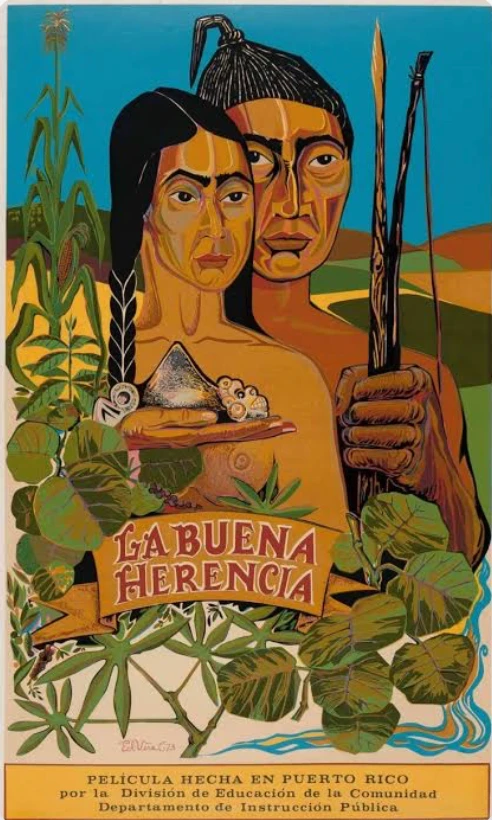
“Taina” was written by a Cuban composer (Mario Tenorio Hevia), recorded by Cuban artists (Celia Cruz and the Sonora Matancera), and released in 1960 by Seeco, a New York label selling mostly to Cuban and Latin audiences. By then the word had been in Cuban and US academic writing for decades. Puerto Rico’s government campaign implementing the taino concept came later, through DIVEDCO in 1967–68. The two timelines are separate: Cuba’s academic track reached popular music first, and Puerto Rico’s public rollout came in 1967 with the movie La Buena Herencia.
1967
DIVEDCO film, La Buena Herencia ↗
First public introduction of taino after a nearly two-decade campaign to marginalize Jíbaro culture and replace it with taino.
1968
DIVEDCO, Isla y pueblo ↗
Primary-school text to place taino in Puerto Rico’s education system, and the first documented text with the spelling Boriken.
1972–73
Carrero, Puerto Rico and the Puerto Ricans (Prince George’s County, Maryland) ↗
The first documented use of taino in U.S. schools outside Puerto Rico.
1977
Hernández Aquino, Diccionario de voces indígenas de Puerto Rico ↗
Dictionary of Indigenous words of Puerto Rico.
1978
Paseo Taino founded, Puerto Rico
First attempt of tainocentric individuals to colonize Jíbaro music as taino.
late 1970s
1982
Caney Indian Spiritual Circle founded as a church, Pittsburgh
New Age–centered taino church, relying heavily on pan–Native American programming.
1988
Arrom, edition of Pané’s Relación acerca de las antigüedades de los indios ↗
Modern interpretation of Pané’s account (volume 2, 1994).
c. 1990
Taino Nation of the Antilles founded, New York area
Pan–Native American organization drawing on broad Native American culture to “revive” taino culture.
1990–92
Irving Rouse, The Tainos: Rise and Decline of the People who Greeted Columbus ↗
Academically standardized, pan-Native modern interpretation of a taino people.
1992
Consejo General de Tainos Borikanos and Concilio Taino Guatu-Ma-cu A Borikén (nonprofit) founded, Puerto Rico
Performance-centered groups, often traveling island-wide to perform modern choreographed dances presented as possibly traditional.
1992
Piri Thomas and Suzie Dod, Puerto Rico: 500 Years of Oppression (Social Justice) ↗
Overt taino propaganda article, widely cited as Thomas & Dod.
1998
United Confederation of Taino People (nonprofit)
Internally structured taino organization designed to model a Native American “tribe,” using language such as enrollment, and becoming politically active with a focus on “recognition efforts” (federal recognition as a Native American tribe through the Office of Federal Acknowledgment, and international recognition as a Native American tribe through the United Nations).
2000–present
More organizations founded
Ku Karey Spiritual Circle (nonprofit; New York, 2000), Naguake (nonprofit; Puerto Rico, 2004), Guabancex Viento y Agua (Dominican Republic, 2008), Higuayagua Taino of the Caribbean (nonprofit; New York area, 2011), Ya’Ya’ Guaili Ara (Bronx, 2012).
2001
Martínez-Cruzado, Mitochondrial DNA Analysis Reveals Substantial Native American Ancestry in Puerto Rico ↗
Most cited taino talking point, and also the most distorted DNA study used to advance the taino concept (the study is where “60% of Puerto Ricans have taino DNA” comes from).
2006
Haslip-Viera, The Politics of Taino Revivalism (Centro Journal) ↗
Paper criticizing Martínez-Cruzado’s 2001 DNA study; the first real public paper challenging erroneous taino claims.
2015
Haslip-Viera, The “Indigenous” or “Neo-Taino” Movement ↗
Critical insight into the neo-taino movement.
2020
Schroeder et al., Genomic Insights into the Early Peopling of the Caribbean ↗
DNA paper that did not use taino, due to the term being limited in scope.
2021
Randle Sloan, La fabricación del taino ↗
Doctoral thesis debunking the taino concept.
2025
Tanya Rodriguez, The Taino Lie; The Genome Grift; The Conversion Code ↗
Three papers documenting the origin of taino, the methodology of the DNA grift of taino, and how tainoism uses psychological manipulation to convert identity seekers into becoming taino.
2026
The Archive – taino →
The most comprehensive resource debunking the taino concept in the world.